
Eastern Rite:
Conception of St. John the Baptist
Roman Rite:
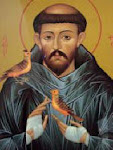
St. Padre Pio da Pietrelcina (1887-1968)
In one of the largest such ceremonies in history, Pope John Paul II canonized Padre Pio of Pietrelcina on June 16, 2002. It was the 45th canonization ceremony in Pope John Paul's pontificate. More than 300,000 people braved blistering heat as they filled St. Peter's Square and nearby streets. They heard the Holy Father praise the new saint for his prayer and charity. "This is the most concrete synthesis of Padre Pio's teaching," said the pope. He also stressed Padre Pio's witness to the power of suffering. If accepted with love, the Holy Father stressed, such suffering can lead to "a privileged path of sanctity."
Many people have turned to the Italian Capuchin Franciscan to intercede with God on their behalf; among them was the future Pope John Paul II. In 1962, when he was still an archbishop in Poland, he wrote to Padre Pio and asked him to pray for a Polish woman with throat cancer. Within two weeks, she had been cured of her life-threatening disease.
Born Francesco Forgione, Padre Pio grew up in a family of farmers in southern Italy. Twice (1898-1903 and 1910-17) his father worked in Jamaica, New York, to provide the family income.
At the age of 15, Francesco joined the Capuchins and took the name of Pio. He was ordained in 1910 and was drafted during World War I. After he was discovered to have tuberculosis, he was discharged. In 1917 he was assigned to the friary in San Giovanni Rotondo, 75 miles from the city of Bari on the Adriatic.
On September 20, 1918, as he was making his thanksgiving after Mass, Padre Pio had a vision of Jesus. When the vision ended, he had the stigmata in his hands, feet and side.
Life became more complicated after that. Medical doctors, Church authorities and curiosity seekers came to see Padre Pio. In 1924 and again in 1931, the authenticity of the stigmata was questioned; Padre Pio was not permitted to celebrate Mass publicly or to hear confessions. He did not complain of these decisions, which were soon reversed. However, he wrote no letters after 1924. His only other writing, a pamphlet on the agony of Jesus, was done before 1924.
Padre Pio rarely left the friary after he received the stigmata, but busloads of people soon began coming to see him. Each morning after a 5 a.m. Mass in a crowded church, he heard confessions until noon. He took a mid-morning break to bless the sick and all who came to see him. Every afternoon he also heard confessions. In time his confessional ministry would take 10 hours a day; penitents had to take a number so that the situation could be handled. Many of them have said that Padre Pio knew details of their lives that they had never mentioned.
Padre Pio saw Jesus in all the sick and suffering. At his urging, a fine hospital was built on nearby Mount Gargano. The idea arose in 1940; a committee began to collect money. Ground was broken in 1946. Building the hospital was a technical wonder because of the difficulty of getting water there and of hauling up the building supplies. This "House for the Alleviation of Suffering" has 350 beds.
A number of people have reported cures they believe were received through the intercession of Padre Pio. Those who assisted at his Masses came away edified; several curiosity seekers were deeply moved. Like St. Francis, Padre Pio sometimes had his habit torn or cut by souvenir hunters.
One of Padre Pio’s sufferings was that unscrupulous people several times circulated prophecies that they claimed originated from him. He never made prophecies about world events and never gave an opinion on matters that he felt belonged to Church authorities to decide. He died on September 23, 1968, and was beatified in 1999.
Comment:
At Padre Pio's canonization Mass in 2002, Pope John Paul II referred to that day's Gospel (Matthew 11:25-30) and said: “The Gospel image of 'yoke' evokes the many trials that the humble Capuchin of San Giovanni Rotondo endured. Today we contemplate in him how sweet is the 'yoke' of Christ and indeed how light the burden are whenever someone carries these with faithful love. The life and mission of Padre Pio testify that difficulties and sorrows, if accepted with love, transform themselves into a privileged journey of holiness, which opens the person toward a greater good, known only to the Lord.”
Quote:
"The life of a Christian is nothing but a perpetual struggle against self; there is no flowering of the soul to the beauty of its perfection except at the price of pain" (saying of Padre Pio).
Saint of the Day
Lives, Lessons and Feast
By Leonard Foley, O.F.M.; revised by Pat McCloskey, O.F.M.
Contributor

- Michael Teixeira, SFO
- I am a professed Third Order Franciscan since 2002. I have dedicated my life to living and following the Rule of the Secular Franciscan Order. I have been the Vice-Minister and Minister of my local fraternity. Recently, my faith journey has taken me east to the Byzantine Catholic Church. I look forward to spreading the work of Saint Francis in my new found home. Even more recently I find that I am being called to walk more closely in the footsteps of Saint Francis. Our world is in desperate need a restoration of Faith, Hope and Charity. It is to this end that I devote my life.
Thursday, September 23, 2010


Saints of the Day: September 22
Eastern Rite:
St. Phocas (d. 102 A.D.)
St. Jonas (d 761 B.C)
Roman Rite:
St. Lawrence Ruiz and Companions
St. Phocas (d. 102 A.D.)
St. Jonas (d 761 B.C)
Roman Rite:
St. Lawrence Ruiz and Companions
Monday, September 20, 2010
Saints of the Day: September 20
Eastern Rite Saints
Saints Eustace (Placidus) Theopista, Agapius, & Theopistus (d. 118 A.D.)
The great soldier - martyr and his wife and sons. They were put to death as Christians under the Emperor Hadrian.
Roman Rite Saints:
Saints Andrew Kim Taegon, Paul Chong, Hasang and Companions (d 1839 - 1867)
This first native Korean priest was the son of Korean converts. His father, Ignatius Kim, was martyred during the persecution of 1839 and was beatified in 1925. After Baptism at the age of 15, Andrew traveled 1,300 miles to the seminary in Macao, China. After six years he managed to return to his country through Manchuria. That same year he crossed the Yellow Sea to Shanghai and was ordained a priest. Back home again, he was assigned to arrange for more missionaries to enter by a water route that would elude the border patrol. He was arrested, tortured and finally beheaded at the Han River near Seoul, the capital.
Paul Chong Hasang was a seminarian, aged 45.
Christianity came to Korea during the Japanese invasion in 1592 when some Koreans were baptized, probably by Christian Japanese soldiers. Evangelization was difficult because Korea refused all contact with the outside world except for bringing taxes to Beijing annually. On one of these occasions, around 1777, Christian literature obtained from Jesuits in China led educated Korean Christians to study. A home Church began. When a Chinese priest managed to enter secretly a dozen years later, he found 4,000 Catholics, none of whom had ever seen a priest. Seven years later there were 10,000 Catholics. Religious freedom came in 1883.
When Pope John Paul II visited Korea in 1984 he canonized, besides Andrew and Paul, 98 Koreans and three French missionaries who had been martyred between 1839 and 1867. Among them were bishops and priests, but for the most part they were lay persons: 47 women, 45 men.
Among the martyrs in 1839 was Columba Kim, an unmarried woman of 26. She was put in prison, pierced with hot tools and seared with burning coals. She and her sister Agnes were disrobed and kept for two days in a cell with condemned criminals, but were not molested. After Columba complained about the indignity, no more women were subjected to it. The two were beheaded. A boy of 13, Peter Ryou, had his flesh so badly torn that he could pull off pieces and throw them at the judges. He was killed by strangulation. Protase Chong, a 41-year-old noble, apostatized under torture and was freed. Later he came back, confessed his faith and was tortured to death.
Today, there are almost 4.7 million Catholics in Korea.
Comment:
We marvel at the fact that the Korean Church was strictly a lay Church for a dozen years after its birth. How did the people survive without the Eucharist? It is no belittling of this and other sacraments to realize that there must be a living faith before there can be a truly beneficial celebration of the Eucharist. The sacraments are signs of God's initiative and response to faith already present. The sacraments increase grace and faith, but only if there is something ready to be increased.
Quote:
"The Korean Church is unique because it was founded entirely by lay people. This fledgling Church, so young and yet so strong in faith, withstood wave after wave of fierce persecution. Thus, in less than a century, it could boast of 10,000 martyrs. The death of these martyrs became the leaven of the Church and led to today's splendid flowering of the Church in Korea. Even today their undying spirit sustains the Christians in the Church of silence in the north of this tragically divided land" (Pope John Paul II, speaking at the canonization).
Saint of the Day
Lives, Lessons and Feast
By Leonard Foley, O.F.M.; revised by Pat McCloskey, O.F.M.
Saints Eustace (Placidus) Theopista, Agapius, & Theopistus (d. 118 A.D.)
The great soldier - martyr and his wife and sons. They were put to death as Christians under the Emperor Hadrian.
Roman Rite Saints:
Saints Andrew Kim Taegon, Paul Chong, Hasang and Companions (d 1839 - 1867)
This first native Korean priest was the son of Korean converts. His father, Ignatius Kim, was martyred during the persecution of 1839 and was beatified in 1925. After Baptism at the age of 15, Andrew traveled 1,300 miles to the seminary in Macao, China. After six years he managed to return to his country through Manchuria. That same year he crossed the Yellow Sea to Shanghai and was ordained a priest. Back home again, he was assigned to arrange for more missionaries to enter by a water route that would elude the border patrol. He was arrested, tortured and finally beheaded at the Han River near Seoul, the capital.
Paul Chong Hasang was a seminarian, aged 45.
Christianity came to Korea during the Japanese invasion in 1592 when some Koreans were baptized, probably by Christian Japanese soldiers. Evangelization was difficult because Korea refused all contact with the outside world except for bringing taxes to Beijing annually. On one of these occasions, around 1777, Christian literature obtained from Jesuits in China led educated Korean Christians to study. A home Church began. When a Chinese priest managed to enter secretly a dozen years later, he found 4,000 Catholics, none of whom had ever seen a priest. Seven years later there were 10,000 Catholics. Religious freedom came in 1883.
When Pope John Paul II visited Korea in 1984 he canonized, besides Andrew and Paul, 98 Koreans and three French missionaries who had been martyred between 1839 and 1867. Among them were bishops and priests, but for the most part they were lay persons: 47 women, 45 men.
Among the martyrs in 1839 was Columba Kim, an unmarried woman of 26. She was put in prison, pierced with hot tools and seared with burning coals. She and her sister Agnes were disrobed and kept for two days in a cell with condemned criminals, but were not molested. After Columba complained about the indignity, no more women were subjected to it. The two were beheaded. A boy of 13, Peter Ryou, had his flesh so badly torn that he could pull off pieces and throw them at the judges. He was killed by strangulation. Protase Chong, a 41-year-old noble, apostatized under torture and was freed. Later he came back, confessed his faith and was tortured to death.
Today, there are almost 4.7 million Catholics in Korea.
Comment:
We marvel at the fact that the Korean Church was strictly a lay Church for a dozen years after its birth. How did the people survive without the Eucharist? It is no belittling of this and other sacraments to realize that there must be a living faith before there can be a truly beneficial celebration of the Eucharist. The sacraments are signs of God's initiative and response to faith already present. The sacraments increase grace and faith, but only if there is something ready to be increased.
Quote:
"The Korean Church is unique because it was founded entirely by lay people. This fledgling Church, so young and yet so strong in faith, withstood wave after wave of fierce persecution. Thus, in less than a century, it could boast of 10,000 martyrs. The death of these martyrs became the leaven of the Church and led to today's splendid flowering of the Church in Korea. Even today their undying spirit sustains the Christians in the Church of silence in the north of this tragically divided land" (Pope John Paul II, speaking at the canonization).
Saint of the Day
Lives, Lessons and Feast
By Leonard Foley, O.F.M.; revised by Pat McCloskey, O.F.M.
Saints of the Day: September 19
Eastern Rite Saints
Saints Trophimus, Sabbatius & Dorymedont (d. 277 A.D.)
Roman Rite Saint:
St. Januarius (d. 305 A.D.)
Saints Trophimus, Sabbatius & Dorymedont (d. 277 A.D.)
Roman Rite Saint:
St. Januarius (d. 305 A.D.)
Saturday, September 18, 2010
Saints of the Day
Eastern Rite Saint:
St. Eumenius (d. 2nd half of the 3rd century)
Wonderworker and Bishop of Gortyna on the Island of Crete. He was known for his charity. He died in exile.
Roman Rite Saint:
St. Joseph of Cupertino (Franciscan)
Joseph is most famous for levitating at prayer.
Already as a child, Joseph showed a fondness for prayer. After a short career with the Capuchins, he joined the Conventuals. Following a brief assignment caring for the friary mule, Joseph began his studies for the priesthood. Though studies were very difficult for him, Joseph gained a great deal of knowledge from prayer. He was ordained in 1628.
Joseph’s tendency to levitate during prayer was sometimes a cross; some people came to see this much as they might have gone to a circus sideshow. Joseph’s gift led him to be humble, patient and obedient, even though at times he was greatly tempted and felt forsaken by God. He fasted and wore iron chains for much of his life.
The friars transferred Joseph several times for his own good and for the good of the rest of the community. He was reported to and investigated by the Inquisition; the examiners exonerated him.
Joseph was canonized in 1767. In the investigation preceding the canonization, 70 incidents of levitation are recorded.
Comment:
While levitation is an extraordinary sign of holiness, Joseph is also remembered for the ordinary signs he showed. He prayed even in times of inner darkness, and he lived out the Sermon on the Mount. He used his "unique possession" (his free will) to praise God and to serve God’s creation.
Quote:
"Clearly, what God wants above all is our will which we received as a free gift from God in creation and possess as though our own. When a man trains himself to acts of virtue, it is with the help of grace from God from whom all good things come that he does this. The will is what man has as his unique possession" (St. Joseph of Cupertino, from the reading for his feast in the Franciscan breviary).
Patron Saint of:
Air travelers
Astronauts
Pilots
St. Eumenius (d. 2nd half of the 3rd century)
Wonderworker and Bishop of Gortyna on the Island of Crete. He was known for his charity. He died in exile.
Roman Rite Saint:
St. Joseph of Cupertino (Franciscan)
Joseph is most famous for levitating at prayer.
Already as a child, Joseph showed a fondness for prayer. After a short career with the Capuchins, he joined the Conventuals. Following a brief assignment caring for the friary mule, Joseph began his studies for the priesthood. Though studies were very difficult for him, Joseph gained a great deal of knowledge from prayer. He was ordained in 1628.
Joseph’s tendency to levitate during prayer was sometimes a cross; some people came to see this much as they might have gone to a circus sideshow. Joseph’s gift led him to be humble, patient and obedient, even though at times he was greatly tempted and felt forsaken by God. He fasted and wore iron chains for much of his life.
The friars transferred Joseph several times for his own good and for the good of the rest of the community. He was reported to and investigated by the Inquisition; the examiners exonerated him.
Joseph was canonized in 1767. In the investigation preceding the canonization, 70 incidents of levitation are recorded.
Comment:
While levitation is an extraordinary sign of holiness, Joseph is also remembered for the ordinary signs he showed. He prayed even in times of inner darkness, and he lived out the Sermon on the Mount. He used his "unique possession" (his free will) to praise God and to serve God’s creation.
Quote:
"Clearly, what God wants above all is our will which we received as a free gift from God in creation and possess as though our own. When a man trains himself to acts of virtue, it is with the help of grace from God from whom all good things come that he does this. The will is what man has as his unique possession" (St. Joseph of Cupertino, from the reading for his feast in the Franciscan breviary).
Patron Saint of:
Air travelers
Astronauts
Pilots
Saints of the Day: September 17
Eastern Rite Saints:
Sts. Sophia and her Three Daughters, Faith Hope and Charity
Roman Rite Saint:
St. Robert Bellamire (d. 1621 A.D.)
Sts. Sophia and her Three Daughters, Faith Hope and Charity
Roman Rite Saint:
St. Robert Bellamire (d. 1621 A.D.)
Subscribe to:
Posts (Atom)